

Débitmètre pour turbine à gaz
- Nom d'article: Débitmètre pour turbine à gaz


- Description du produit
-
Introduction
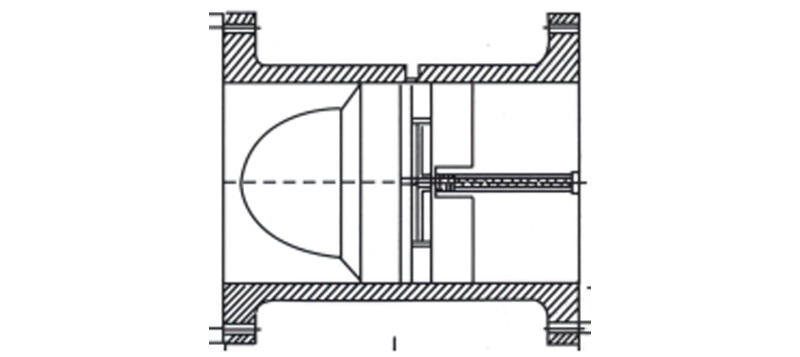
The gas turbine flowmeter is a velocity-type flow instrument that accurately measures gas flow. It has advantages such as simple and lightweight structure, high measurement accuracy, good repeatability, wide measurement range, and convenient installation and maintenance. It is widely used in various gases in industries such as petroleum, chemical, metallurgy, aviation, scientific research, etc., including natural gas, city gas, propane, butane, air, nitrogen, and more. Due to its high accuracy and good repeatability, it is suitable for trade measurement and industrial process monitoring.
Working Principle
When the gas flow enters the flowmeter housing, under the action of the fluid, due to the angle between the turbine blades and the fluid flow direction, a torque is generated on the turbine. The turbine starts to rotate after overcoming the resistance torque and friction torque. When the torques reach equilibrium, the rotation speed stabilizes, and the turbine's rotational speed has a linear relationship with the flow rate. The magnets on the rotating signal disk periodically change the magnetic resistance of the sensor, thereby inducing a pulse signal at both ends of the sensor that is proportional to the volumetric flow rate of the fluid. This signal is amplified by a preamplifier and processed together with pressure and temperature signals detected by pressure and temperature sensors to directly display standard volumetric flow rate and total standard volume.
Product Features
1. High accuracy, good repeatability, low pressure loss, good shock resistance;
2. Uses high-quality bearings with low friction resistance and good sealing;
3. Integrates microprocessor, flow sensor, high-precision temperature and pressure sensors to directly measure the flow rate, temperature, and pressure of the measured gas while automatically performing flow tracking compensation and compressibility factor correction calculations;
4. The instrument has pulse signal and analog signal output, which can be centralized for data collection and real-time management through RS485 communication interface or system;
5. Low power consumption; can be powered by an internal battery or external power supply; field display type LCD screen is clear and intuitive with low power consumption; a 3V lithium battery can operate for over 5 years;
6. Has real-time data storage function to prevent data loss during battery replacement or sudden power failure; internal data can be permanently saved during power outage;
7. Can be used with IC card prepaid systems for convenient trade settlement;
8. Made of 1Cr18Ni9Ti stainless steel structure (turbine uses 2Cr13) with good corrosion resistance;
9. Easy to maintain with a self-rectifying structure; small and lightweight with a simple design that allows for quick assembly and disassembly; internal cleaning is straightforward;
10. Strong anti-magnetic interference and shock resistance; reliable performance with long service life;
11. Low lower limit flow rate with a wide measurement range;
Main Technical Parameters
1. Standard: GB/T 18940-2003 'Measurement of Gas Flow in Closed Pipelines - Turbine Flowmeter'
2. Accuracy LevelLevel 1.0: Qmax-0.2max ±1.0% 0.2max-Qmin ±2.0%
Level 1.5: Qmax-0.2max ±1.5% 0.2max-Qmin ±3.0%
3. Nominal Diameter: 25mm~300mm;
4. Measured Medium: Natural gas, coal gas, air, etc.;
5. Ambient Temperature: -20℃~+50℃;
6. Measured Medium Temperature: -20℃~+80℃;
7. Nominal Pressure: 1.6MPa, 2.5MPa, 4.0MPa;
8. Explosion-proof Mark: ExibⅡBT4 ExdⅡBT6;
9. Output Signal: Voltage pulse, 4~20mA;
10. Communication Interface: Optional RS-485 communication interface;
11. Power Supply: Sensor: +5V~+24VDC (external); Transmitter: +24VDC (external), Flowmeter: 3.0V lithium battery (built-in).
Instrument Selection
1. Selection Parameter Table
LWGQ□ [□□□] [□] [□] [□] [Description] [Type]
[Model][LWGQ] [Basic model], +12V power supply, pulse output, high level ≥8V
[Low level ≤0.8V][LWGQA] [4~20mA two-wire current output, remote transmission type] [LWGQB] [Battery-powered field display type] [LWGQC] [Field display/4~20mA two-wire current output] [Nominal]
[Diameter]
[25mm], ordinary turbine flow range of 2~20m3/h
[Wide range turbine of]4~40m3/h25 [40mm], ordinary turbine flow range of]3~50m3/h
[50mm], ordinary turbine flow range of]5~100m3/h40 [Wide range turbine of]10~150m3/h 50 50mm,普通涡轮流量范围5~100m3/h
宽量程涡轮为10~150m3/h80 80mm, the normal turbine flow range is 10 to 240 m3/h
The wide range turbine is 20 to 480 m3/h100 100mm, the normal turbine flow range is 12 to 360 m3/h
La turbine à large plage est de 20 à 600 m3/h150 150mm, la plage de débit normale de la turbine est de 25 à 1000 m3/h
La turbine à large plage est de 40 à 1500 m3/h200 200mm, la plage de débit normale de la turbine est de 50 à 2000 m3/h
La turbine à large plage est de 75 à 2500 m3/h250 250mm, la plage de débit normale de la turbine est de 80 à 3500 m3/h
La turbine à large plage est de 160 à 4000 m3/h300 300mm, la plage de débit normale de la turbine est de 300 à 6500 m3/h Explosion-proof
ExplosionPas de marquage, type non antidéflagrant B Type antidéflagrant Précision
NiveauA Niveau de précision 1.0 B Niveau de précision 1.5 Turbine
TypeA Turbine à large plage B Turbine normale 2. Sélection du débitmètre
2.1. Champ d'application
a. La plage de débit requise doit être inférieure au tableau des paramètres de sélection, et il y a des exigences strictes pour le débit de démarrage ;
b. Il ne doit pas y avoir de courtes interruptions ni de grandes fluctuations dans le fluide ;
c. Convient pour le gaz naturel, le gaz de ville, l'air comprimé, l'azote, etc.
2.2. Détermination des spécifications
Les utilisateurs doivent estimer le débit volumétrique maximal et minimal de la canalisation en fonction du volume de transmission de gaz, des plages possibles de température et de pression du milieu, et sélectionner correctement les spécifications du débitmètre. Lorsque les deux tailles de débitmètres peuvent couvrir le débit volumétrique minimal et maximal, un diamètre plus petit doit être choisi dans la limite de la perte de pression admissible. Calculer la plage de débit en conditions de fonctionnement en fonction de la plage de débit et de la pression du milieu dans des conditions standard.
Mots-clés :
Demande de produit
Si vous êtes intéressé par nos produits, veuillez laisser votre e-mail, nous vous contacterons dès que possible, merci !
Produits connexes

Adresse :
Comté de NanPi, ville de Cangzhou, province du Hebei
OEM
Des dessins de conception précis, aux processus de production rigoureux, jusqu'aux tests de qualité stricts, nous défendons toujours l'esprit d'ingéniosité, la recherche de chaque détail de la perfection. Notre équipe possède une riche expérience industrielle et une forte expertise technique, selon vos besoins spécifiques, pour fournir des services personnalisés sur mesure, afin de garantir que chaque produit puisse répondre à vos attentes.